What Actually Defines the Arcade Puzzle Genre?
let's be real, this is actually about versus arcade puzzle gaming in particular
If you spend any length of time playing the genre beyond Tetris or Puyo, it's pretty clear that it has a lot of blurry edges. Genre staples like separate boards, directly controlling pieces that match and clear when collected into groups or drawing lines are stable concepts but not requirements; on the contrary, deviance from one or more genre staples is pretty typical. It's difficult to think of a genre that operates like this outside of other wastebasket groupings like "casual", but I would argue that there are plenty of unifying concepts to build a genre around.
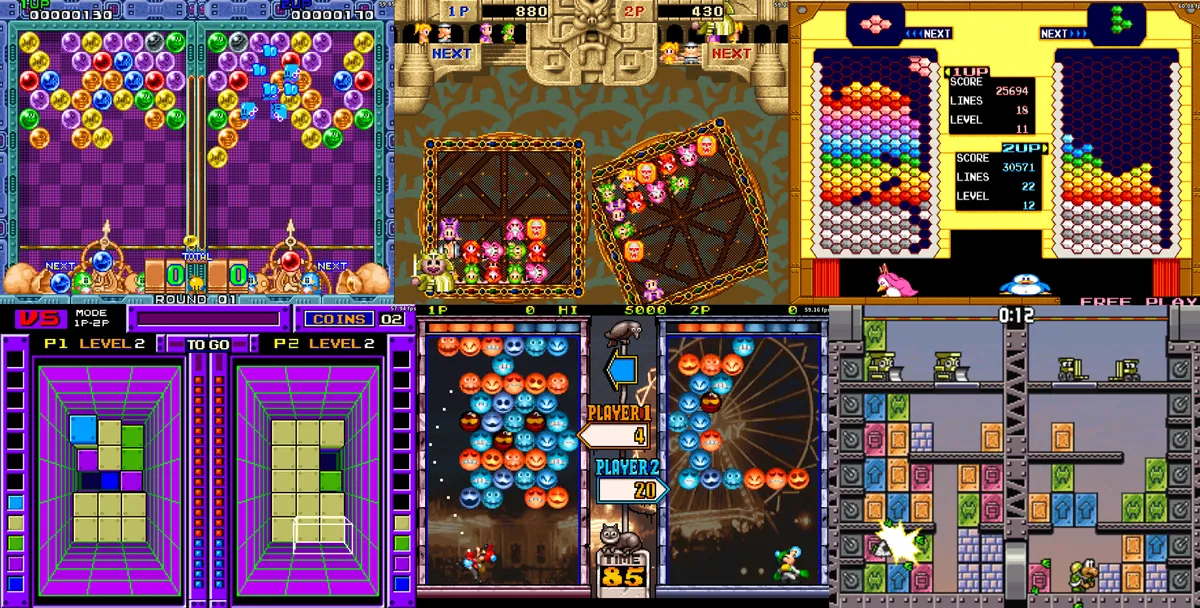
The most important qualities core to the genre is that information about the game state is public information and discrete, but what a board represents is abstract and requires time to understand. This is unusual in pvp games which are usually concrete and straightforward, but hide information: fighting games are premised on hidden information in the same manner as rock-paper-scissors; strategy uses fog of war to hide information from players so they can outwit each other; and FPS players are limited to their immediate perspective and what they can hear. The diegesis provides both a perspective for information to reach you as well as a narrative explanation for the game events. Ryu is punched, so he loses health; Zerg drones get blasted by Terran marine rushes; and a bullet to the head ends many rounds in an FPS, but there's nothing in TGM that explains why a double or greater sends damage, it's merely a rule of the game.
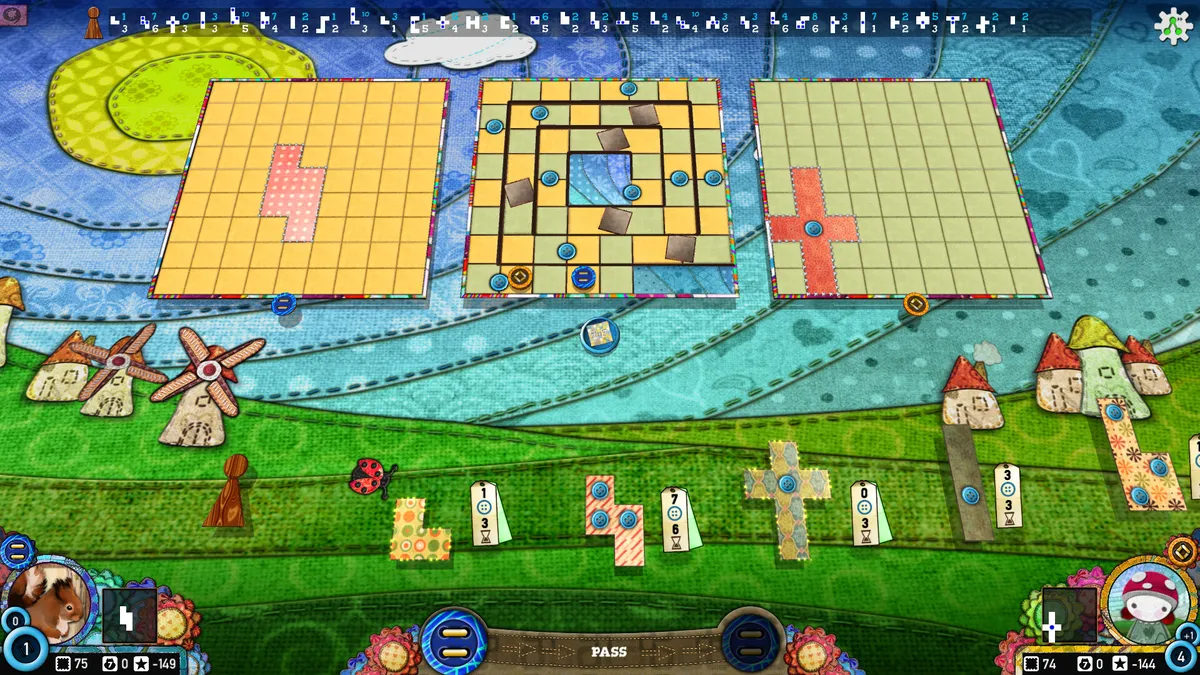
Most puzzle games then are more similar to abstract board games than other video games, and not necessarily Chess, but ones like Uwe Rosenberg's Patchwork, where the "puzzle" is determining how to extract the maximum value from a situation that is randomized but necessarily finite.
However, unlike an abstract board game, players are often limited by time. It takes time to read a board and understand how much of a threat an opponent poses right now; what kind of attacks they might be able to play; what attacks they are most vulnerable to; and so forth and so on. Perhaps there's always a "right answer" for any given board, but if you are too slow finding the right answer and die, that is obviously worse than if you had found a suboptimal answer that lets you at least live.
This built in fuzziness is often what makes the genre exciting, because you simply cannot perform all relevant game actions at once at maximum speed forever, but you must nevertheless choose, and choose as fast as possible. This "Action Economy", where players spend time (rather than turns, like a board game) performing actions like playing pieces, arranging their board, studying their opponent's board, observing the next queue, or simply waiting, is crucial to understanding the genre as a whole. If time is not a limiting factor, some other resource would have to be created in order to create the requisite risk and reward that gives the genre its appeal, and in the board game world, time is often substituted by discrete action points, turns, or some other mechanical device.
Most versus games can be analyzed along these terms too, where players divide their time and attention according to what they think of as their primary concerns: a fighting game player might not be able to anti-air while checking an opponent's meter; an rts player may spend more attention to their minimap and macro-economic concerns than micro-managing the shots of their soldiers; and an FPS player has to decide how much time they want to spend staring down a sniper scope versus maintaining situational awareness.
Because the value of what players can do is directly related to how long it takes to do it, puzzle games often balance particularly powerful things against time. The time it takes for a chain to finish in a game of Puyo Puyo was chosen because it gives an opponent time to come up with and execute a counter strategy. The amount of time and pieces it takes to resolve a powerful Tetris may leave a player vulnerable to a devastating snipe.
However, these options are only available to players who spend the time to be aware of what they're opponent is doing, time not spent on performing other game actions. Sometimes when balancing a game, particular game actions are tuned to allow this observation to take place; the locking animation and spawn delay in TGM was likely created to give the players time to set their gaze on where their next piece will be, on top of being a convenient time to start watching an opponent. These starts and stops, or the vulnerabilities created by previous commitments, is probably familiar to fighting game players, who rely on hitstop or counter animations to confirm their combos, or who are punished by the lengthy recovery of their most powerful moves when they miss or are blocked.
Puzzle games do have a few affordances to help communicate and organize information; many games have small damage queues to inform the player that damage will arrive after a piece is played. Some games have animated cut-ins to alert distracted players to a dramatic swing in momentum or when their opponent makes a particular kind of attack. Audio cues are often quite common to alert players or communicate relevant game state information; the particular balance of what deserves audio cues, animated sequences, or even dead stops to gameplay determines the particular balance of a puzzle game: if an action would have too severe of an effect on an unaware player, then using one of these affordances can help soften the blow or let the player expend less energy on tracking the particulars of game events happening away from their board.
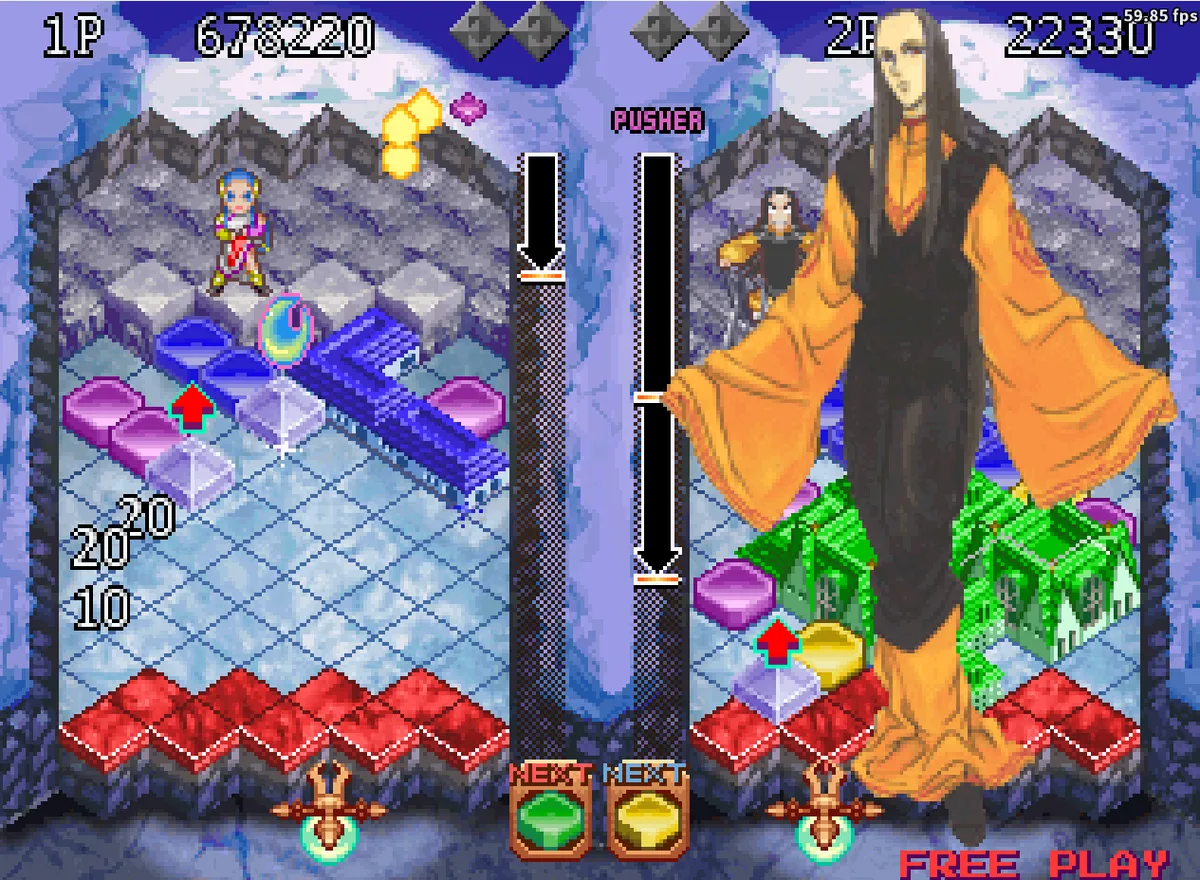
Most if not all game actions have an associated sound effect, from rotating a piece to placing it or locking it. By making many game actions possess an audio cue, the relative action economy "cost" of knowing what your opponent is doing (placing pieces, stalling, popping an item...) is "cheaper" as you don't have to break your vision from your board to hear these sounds. The specifics of what they did, the particular vulnerabilities or dangers their board represents, is only revealed by looking directly at their board.
Speaking of organizing information, we discussed previously that information is often discrete: any particular game board is often divided into discrete squares, hexagons, or other shapes, and pieces always occupy discrete, whole number locations after they've been placed; they might float down the board in a smooth tweening animation, but they always come to rest in a grid of some kind. This makes visualizing the spatial nature of the game much simpler, and means that by looking at the board, you can understand where you would need to put a piece to resolve a chain or resolve a dependency. I might not know exactly how far Potemkin's 6H reaches, but I know that an I dependency in Tetris is always 1 wide and at least 3 squares deep.

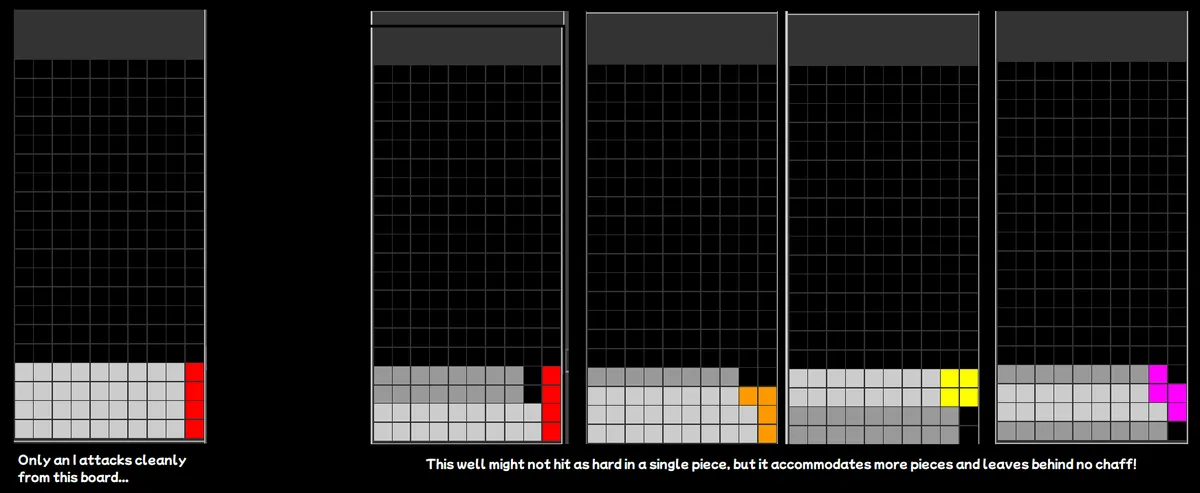
Figuring out what pieces are needed in what order to resolve a particular problem or pose a particular attack is part of the core appeal of the genre, and because each of these problems have a unique texture, the genre poses a startling variety of them. The particular spatial concepts: matching groups, drawing lines, the shapes of the pieces in play, the way pieces collapse or don't, these give each game their own particular identity, and it's not uncommon for a player to stumble onto a gem that feels like it was made "for them".
The controls of your average puzzle game are often quite simple, rarely exceeding a control stick and four face buttons. Player actions are typically either linear or discrete, rather than multi-linear, or analog. Some modal control is typical: tapping a direction will move your piece over a space, but holding it causes it to rapidly move over. A lot of any particular game's texture comes from the particulars of how pieces behave when they rotate against a wall, or if they instantly lock when they come in contact with other pieces, and so on.
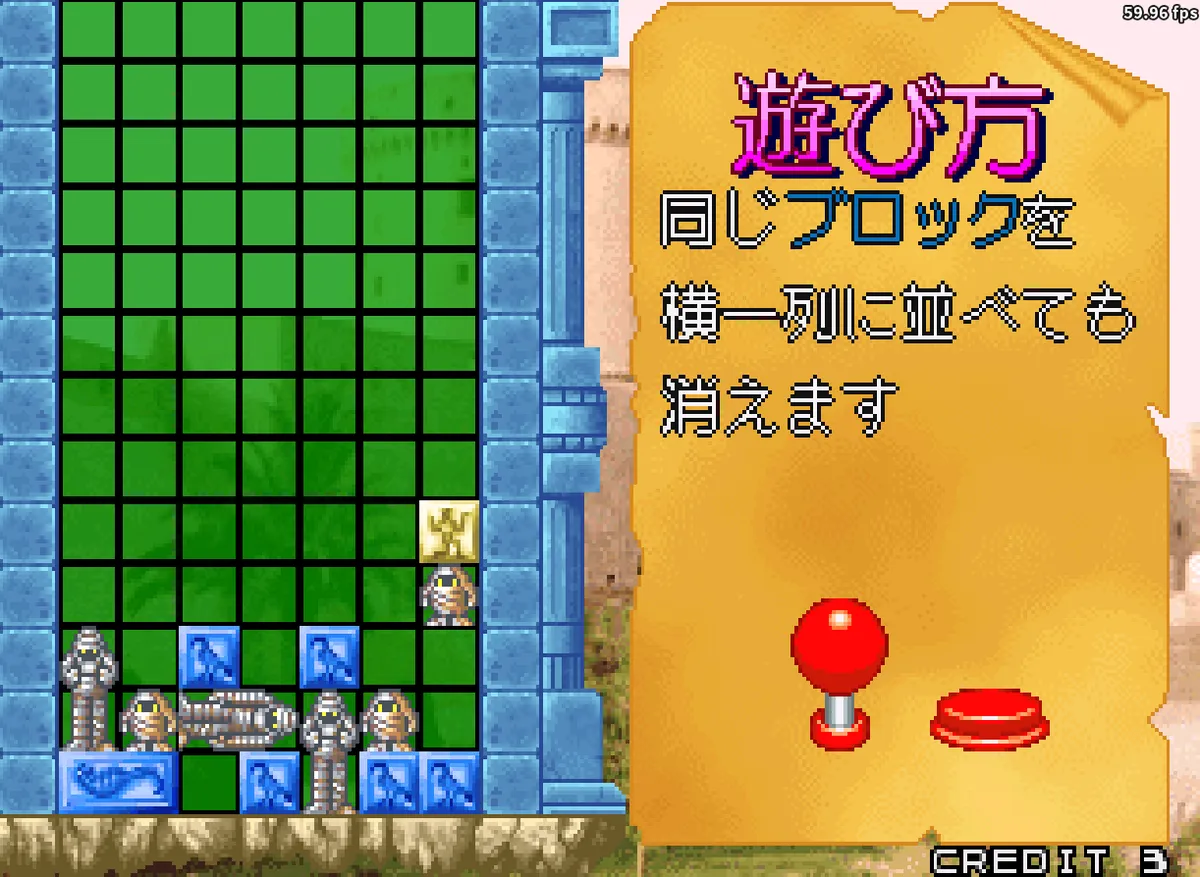
Usually other commands the player has access to are uni-directional; A player can only hold a piece once until they put their active piece down, or a player may press a button to consume or activate a resource that is then depleted. There's only so much design space available for concepts like this, and for new players, accidentally performing these linear actions from which there is no return has the potential to be a little painful and kind of annoying to discover, especially if there were too many of them.
The final puzzle game quality is the genre's relationship to risk. Typically, most puzzle games provide the most powerful attacks and options to the most vulnerable players. A puyo player with a twelve chain on board is much more likely to die to random harassment than one without. A Tetris player requires their board to be filled with potential lines in order to attack in rapid succession. A consequence of this is that players choose to make themselves more vulnerable and reveal information to their opponent about the pieces their strategy depends on in a gradual manner that is completely unlike any other game genre.
I often refer to this behavior as "greeding", because as players participate in this behavior, their opponent gains new opportunities to punish their "greed" and vanquish them before they get an opportunity to fire off the big chain. The game gets more intense as players commit to greater and greater greeds: the amount of time it takes to place pieces diminishes as the board grows taller, the consequences of mistakes get more dire as options get thinner, and often piece dependencies get more and more pronounced because there are fewer places to discard pieces that don't achieve any particular goal. What differentiates this quality from your average "comeback mechanic" is that a properly structured but full board is much stronger than an empty board, but just as vulnerable as a disorganized but full board, whereas your average comeback mechanic is rewarded to losing players, not risking players.
So know that we understand the core conceits to a genre that otherwise has very few formal rules and can contain games like Tetris, Magical Drop, Panel Attack, Puyo, and Puzzle Bobble, we should explore how different games choose to express these qualities to deliver on their core appeal and texture. We would probably say that a game like TGM or Puyo are intensely "interactive", because there are a lot of different strategies players can choose in response to a player's behavior or board state, relative to less interactive games that emphasize player action and speed like Panel Attack or Magical Drop. If Panel Attack or Magical Drop were to become more interactive, it's likely some aspects of the game would have to slow down in order for players to gather the information and make the right decisions to interact, but the core appeal of these games is to be performing one zillion matches a second, so they eschew those interactive elements.
Some games emphasize their economy by altering the balance of time for certain game actions: Dr. Mario is famous its glacial piece falling animation, encouraging players to create very efficient clears, and peppering their opponent with chain damage that takes a very long time to resolve. This frees up the attacking player to gain even more advantage and apply even more pressure. This feedback loop is kept in check with a damage cap, thankfully.
Other games emphasize board management and spatial reasoning: Land Maker has players eliminating colors from their board one by one, because having fewer colors on the board makes it easier to build bigger and more devastating shapes. The color "spilling" mechanic, where pieces turn their adjacent neighbors into the placed piece, lets players remove colors while building their target color at the same time.
That concludes a basic description of what unifies the arcade puzzle genre mechanically, but what about historically? The relative lack of formal rules makes the genre geared towards novelty, and novelty is related to the genre's historical position as cheap entertainment that fulfills particular business goals of various game developers, as well as arcade manufacturers, operators, and console manufacturers.
After all, a puzzle game is fairly economical to develop, does not require particularly advanced hardware, is usually quite different from other offerings, tends to acquire few but very dedicated fans (I suppose we'd call them "whales" nowadays) who enjoy their particular tastes catered to, and the flexibility of the genre means that it can fit into almost any niche the determined can stuff it into. Toryuumon capitalized on Puyo Puyo Tsuu's popularity while reusing hardware that was a decade out of date. Spin Pair was released in 1991 because the Turbo Express was recently released and needed cheap multiplayer games to sell link cables and use its multiplayer features. A similar story occurred with Tetris and the Gameboy. Puzzle games were frequently used to fill out catalogs for multi-game cartridge systems like the Neo Geo or Taito F3.
It was during the move to 3D and also disc based media that largely sent puzzle games into something of a dork age, because they could not use the novelty of 3D or additional media space without compromising their core value of being cheap. You might periodically luck out with a dank game like Musapey no Choco Marker or the stylish Otostaz, but the genre mostly limped on largely as a retro throwback, a small enough product for an indie developer, or as shovelware to fill handheld, browser, or smartphone gaming spaces.
A change in format from a single screen you share with another player to a personal device, especially one that fits into your hand, has largely killed the market for games with pvp as a feature, because there is no convenient way to display an opponent. The console/pc trend of games that feature lobby based play like Tetris 99 or Tricky Towers, as well as the creation of the Tetris Guideline has largely diminished direct player interaction as a conceit. Audiences desire these "cheap" experiences less and less as their time gets shredded by social media and streaming video. Personally, the past decade and change has been a huge bummer even if some wildly cool games have come out despite this. wait that last one is my game, whoops—
I hope that you've enjoyed reading and come away with a better understanding of the genre, its value, its unique qualities, and its history. I tried my best not to ramble too much, because the subject matter is just a little too big for a blog post.